A pest control service Baltimore homeowners keep on file starts with a diagnosis, not a spray can — because the roach under your dishwasher and the mouse behind your kitchen toe-kick both got in through something structural. We inspect first, name the pest, treat what is active, then seal the entry points so the same problem does not walk back in three weeks later.
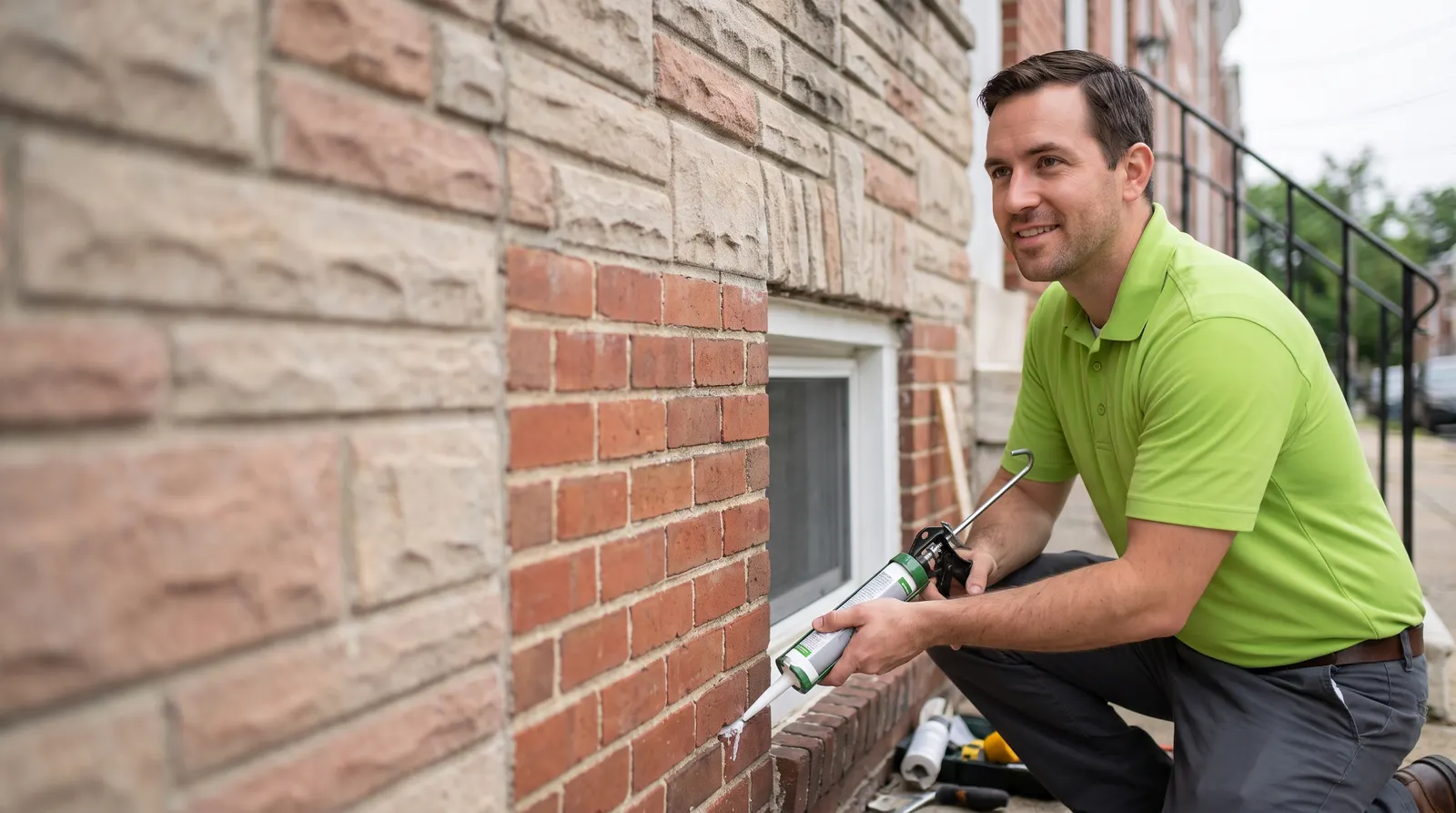
A pest control service in Baltimore is professional work that inspects a home or rental unit, identifies the exact pest, treats the active infestation, and seals the gaps in foundations, party walls, and utility penetrations that let the pest inside.
Every service reflects the same meticulous attention to detail — whether it's a single job or a larger pest control service project across Baltimore.
A pest inspection is the diagnostic visit that names the pest and finds the route it is using. We walk the interior and the exterior: under sinks and behind the range, the toe-kick and dishwasher gasket, the cellar sill plate and joist ends, closet corners and bed frames, then outside along the foundation, the water and gas penetrations, the rear alley wall, downspout boots, and the cornice line where your roof meets the neighbor's. Identification matters because Baltimore homeowners lose weeks buying the wrong product: subterranean termite swarmers have equal-length wings, straight antennae, and a thick waist, while flying ants have a pinched waist and bent antennae, and bat bugs look close enough to bed bugs that only a magnified look settles it. Droppings tell the same story — mouse droppings are rice-grain size and pointed, rat droppings run closer to a bean, and German roach frass looks like ground pepper in cabinet hinges. You get a plain-language report of what is active, where it is entering, and what treatment the building actually needs. Ask for photos of the entry points we find. On-site inspections start at the $250 minimum, and inspection findings roll into the treatment quote.
View details →Mouse control in Baltimore is a construction problem with a trapping schedule attached. Mice enter through gaps as small as a dime, and on a rowhouse they find that gap in a short list of places: where the water line enters the cellar, an unsealed gas penetration, a rotted rear door sweep, a cracked mortar joint behind formstone, a dryer vent with a broken flap, a gap under a cellar door in the rear yard, or the open cavity where a party wall meets the roof deck. We trap and monitor inside — under the sink, behind the range, along the cellar stair stringer where droppings usually show first — then seal with materials rodents cannot chew through: copper mesh packed into pipe chases, sheet metal over gnawed wood, mortar and hardware cloth at foundation cracks. Steel wool rusts and expanding foam alone gets chewed in a season, which is why sealing material choice is the part that decides whether the mice come back . Rodent pressure spikes September through November as overnight temperatures drop, so late August is the best month to book. Rowhouse mouse work with sealing typically runs $350 to $1,200 depending on how many penetrations need closing and whether the cellar is finished.
View details →Rat control needs more hole than mouse control — roughly half an inch of gap — and in Baltimore the openings are usually low and outside. We look for burrows along rear-alley pads, under trash pad slabs, beside cellar stairwells, at the base of fence lines, and in the soft soil behind a shed or a raised planter. Baltimore's continuous rear-alley network functions as a highway between blocks, which is why a neighbor's open bin or a broken alley pad can put pressure on your foundation even when your own yard is clean. Treatment combines exterior burrow work and secured bait placement with structural exclusion: hardware cloth trenched at grade, sheet metal at chewed door bottoms and thresholds, mortar at the sill line, and closing the gap where a downspout or a hose bib passes through brick. Interior trapping runs at the same time if there is evidence in the cellar or first-floor kitchen. Rat work with exterior exclusion typically runs $450 to $1,600, and it holds longest when the whole block trash situation is addressed at the same time — we will tell you plainly if the source is on the far side of the alley wall.
View details →German roach treatment targets the small light-brown roach that lives in kitchens and bathrooms and scatters when the light flips on. German roaches breed on an egg-capsule cycle, so a single spray reaches what is walking and misses what is about to hatch — which is exactly why previous treatments fail four weeks later. Our program uses gel bait placed where the insects actually harbor (cabinet hinges, the dishwasher gasket, the motor housing under the refrigerator, the void behind a sink backsplash, the seam under a countertop overhang) plus an insect growth regulator that interrupts the next generation, across 2 to 3 visits spanning the egg cycle . Baseboard fogging is not the plan; we are baiting where they sleep. In a Baltimore rowhouse conversion or a two-unit stack, we recommend treating adjoining units and the shared cellar together, because roaches travel plumbing stacks and party-wall voids between addresses. You do not need to empty the kitchen — clear food off open counters, empty the toe-kick area, and keep sinks dry the night before. A one-time interior service runs $250 to $475; the multi-visit program runs $375 to $850.
View details →Bed bug treatment starts with confirmation, because bat bugs, carpet beetle larvae, and spider bites all get reported as bed bugs, and the wrong call costs weeks. We inspect mattress seams and piping, box spring corners, headboard bolt holes, the baseboard directly behind the bed, sofa seams, and the underside of nightstand drawers, then show you what we found. Treatment on an occupied unit is a multi-visit process paired with a written prep list: bag and launder bedding and worn clothes on high heat, install mattress and box spring encasements, reduce clutter along walls, and leave furniture in place rather than moving infested items to another room. Bed bug work stays steady year-round in Baltimore's apartments and multi-unit rowhomes, with a modest bump around summer moving weeks and college move-in near the Johns Hopkins Homewood campus. For landlords, we can coordinate access with the tenant and keep the visit brief and low-key. Occupied, furnished rooms typically run $450 to $1,100 per room; vacant units between tenants treat faster because nothing has to be worked around.
View details →A termite inspection tells you whether the winged insects at your basement window in April were subterranean termite swarmers or a harmless ant flight — and whether there is active feeding in the structure. Swarms hit Baltimore hardest on warm, damp days from late March through May, usually near a light source or a below-grade window. Inside, we look for mud tubes on cellar walls and piers, blistered paint on baseboard trim, hollow-sounding joist ends and sill plate, discarded wings on a windowsill, and the moisture conditions that invite the colony in: a leaking hose bib, a downspout dumping at the foundation, or a cellar floor that sweats through August humidity. On a rowhouse we check both party wall sides and the front vestibule slab, since termites follow the soil line under continuous foundations. You get written findings you can hand to a buyer, a lender, or a contractor. Booking in February or early March gets ahead of the swarm rush. Termite inspections run $250 to $400, and the finding decides whether treatment is even needed.
View details →A pest control service in Baltimore is professional work that inspects a home or rental unit, identifies the exact pest, treats the active infestation, and seals the gaps in foundations, party walls, and utility penetrations that let the pest inside.
You get a firm, itemized quote for your pest control service before any work begins — no surprises, no pressure.
Careful prep, tidy work, and a full cleanup when we are done. We treat your home and belongings like our own.
The same trusted, background-checked team from the first call to the final check.
The real decision in Baltimore is not which chemical goes down — it is how far you want the work to go, and that depends on the pest and the building. If you have seen one or two mice and you own a single rowhouse, choose rodent control with entry-point sealing rather than bait alone: baiting drops the current population, but a mouse fits through a gap the width of a dime, so unless the pipe chase, sill plate, and rear-alley wall penetrations get closed, the same route stays open all winter. If you rent and cannot authorize structural work, choose interior trapping and monitoring instead — it is cheaper and faster, and the trade-off is that you are managing a symptom while the hole stays open, so expect repeat visits rather than an end date. If you have German roaches in a kitchen, choose the multi-visit gel bait and growth-regulator program over a single treatment: a one-time service runs $250 to $475 and knocks down what is walking, while the 2-to-3-visit program at $375 to $850 spans the egg cycle, and the trade-off is two more appointments in exchange for actually finishing the job. If you are a landlord with roaches reported in one unit of a rowhouse conversion, treat the adjoining units at the same time — Baltimore's shared party walls, stacked plumbing stacks, and common cellars move roaches between addresses, and the trade-off of treating only the complaining unit is that you pay twice within a season. If you saw winged insects near a basement window in April, book a termite inspection first at $250 to $400 rather than jumping to treatment: a report tells you whether those were subterranean termite swarmers or a harmless ant flight, and treatment on a typical rowhouse runs $900 to $2,800, so the inspection is the cheap decision that protects the expensive one. If your termite finding is limited and you want ongoing evidence, ask about monitoring stations over a full liquid barrier — stations cost less up front and tell you what is active, while a barrier costs more and treats the soil perimeter as one continuous line; the trade-off is up-front dollars versus how long you plan to hold the property. For bed bugs, choose the prep-and-multi-visit treatment path if the unit is furnished and occupied, and expect $450 to $1,100 per room with a written prep list — the trade-off is that your cooperation on laundry, clutter, and encasements does a third of the work. If the bed bug unit is empty between tenants, the same rooms treat faster and cheaper because there is nothing to move, so schedule it in the vacancy window rather than after the new lease starts. For mosquitoes and ticks around a Patterson Park or Roland Park yard, single visits at $250 to $375 make sense for a graduation party or a wedding weekend, while an April-through-October program makes sense if you actually use the yard nightly; the trade-off is one appointment for one evening versus recurring visits that hold pressure down through July and August humidity. If your problem is ants on a kitchen counter, a targeted interior treatment at $250 to $450 usually settles it; if the ants are carpenter ants and you are finding coarse sawdust under a cellar joist or a porch post, treat the nest and fix the moisture source, because carpenter ants follow wet wood and a spray on the trail line will not move them. And if what you want is not to think about it, a quarterly plan at $250 to $400 per visit keeps a perimeter and a set of monitors in place, while a one-time call fits a single event like a wasp nest over the back steps. We will tell you honestly which one your house needs — including when the answer is one visit and nothing more.
Every project gets a firm, written price after a free on-site visit. Ranges below for orientation.
Tell us about your pest control service job and we'll send a clear, written quote — usually the same day. Or just call and talk to a real Baltimore pro.
(667) 309-5375Free estimates for Baltimore & the surrounding area.
 Nexora Bug Control